Part 2: Creative Review & The Eye of Sauron
JUNE 14TH, 2026

The first part of this conversation surfaced something deeper about the brittle reality of legacy digital ecosystems where structural vagueness and automated indifference treat creators as corporate liabilities. To survive, we have to understand the fundamental difference between a community and a dependency structure. A dependency structure centralizes technical capacity and distribution in the hands of a few. Hellooo, Hollywood.
This structure collapses the moment centralized distribution disappears. A true community survives platform migration because its identity and mutual investment exist independently of any corporate algorithm.
Transitioning from dependency to true community requires intentional, relationship-driven infrastructure.
A Case Study in the Creator Review Process
Recently, I uploaded a creative project to Metalabel. The experience was the exact antithesis of the legacy platform loop.
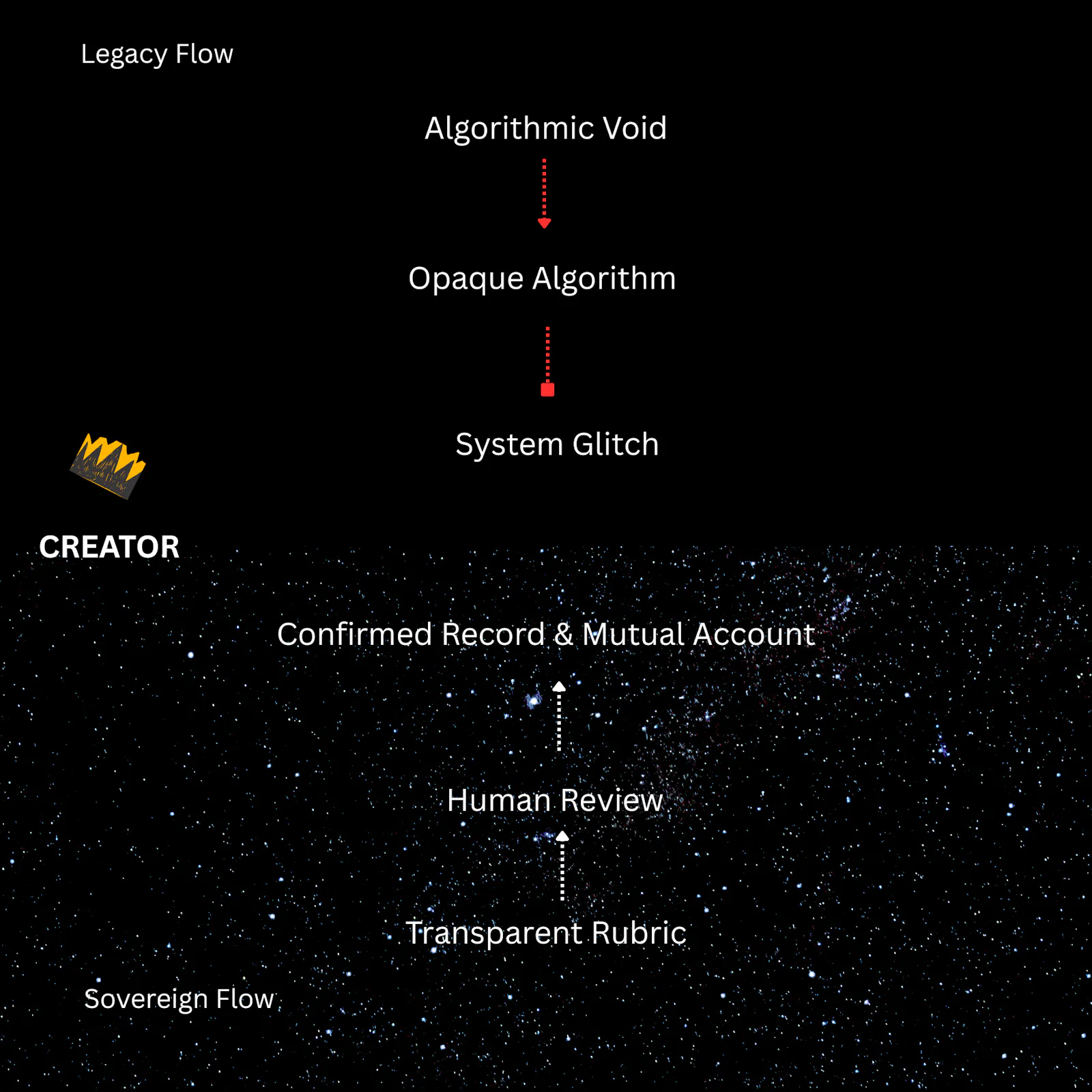
Instead of throwing media at an unfeeling, hyper-optimized algorithmic engine and crossing my fingers, my submission went to an actual curation gate. A human being reviewed it. This meant that regardless of the outcome, a definitive response was guaranteed. This human-centered entry point completely shifts the baseline dynamic between creator and ecosystem:
When you replace an automated black box with a visible process, you build trust equity. The platform functions as a cooperative gallery rather than a feudal lord extracting value.
Passive Scanning vs. Upfront Curation
When an ecosystem scales, it usually defaults to one of two review mechanisms: upload first, ask questions later or upfront review. The crisis with legacy networks is that they have entirely abandoned human curation for passive, automated surveillance.
Legacy tech functions like an automated trap door. You build inside their ecosystem for a decade, and then a passive algorithmic scan suddenly flags an anomaly, dropping a permanent demonetization on your head because there is minimal internal prioritization of brand alignment or human context.
This structural breakdown isn't inevitable; it’s a design opportunity.
Brand Congruity at Scale
When I worked as a marketing analyst at American Express, brand congruity was our absolute North Star. Our research team required strictly approved language across the accounts and product teams to guarantee that a customer experienced the exact same brand alignment and institutional support regardless of which department they interfaced with.
Trust me, I did not take those 17 compliance trainings for nothing! Corporate institutions know exactly how to map out ironclad, standardized operational guardrails when their revenue and reputation depend on it. But I digress.
If a multi-billion-dollar financial institution can prioritize cross-departmental brand congruity to protect customer relationships, a media monopoly can absolutely afford to design systems that protect its creators. Instead, legacy platforms use automation as a shield against human accountability.
But how do we distribute this human-centered care at scale without collapsing under the weight of administrative overhead?


